CECOZ
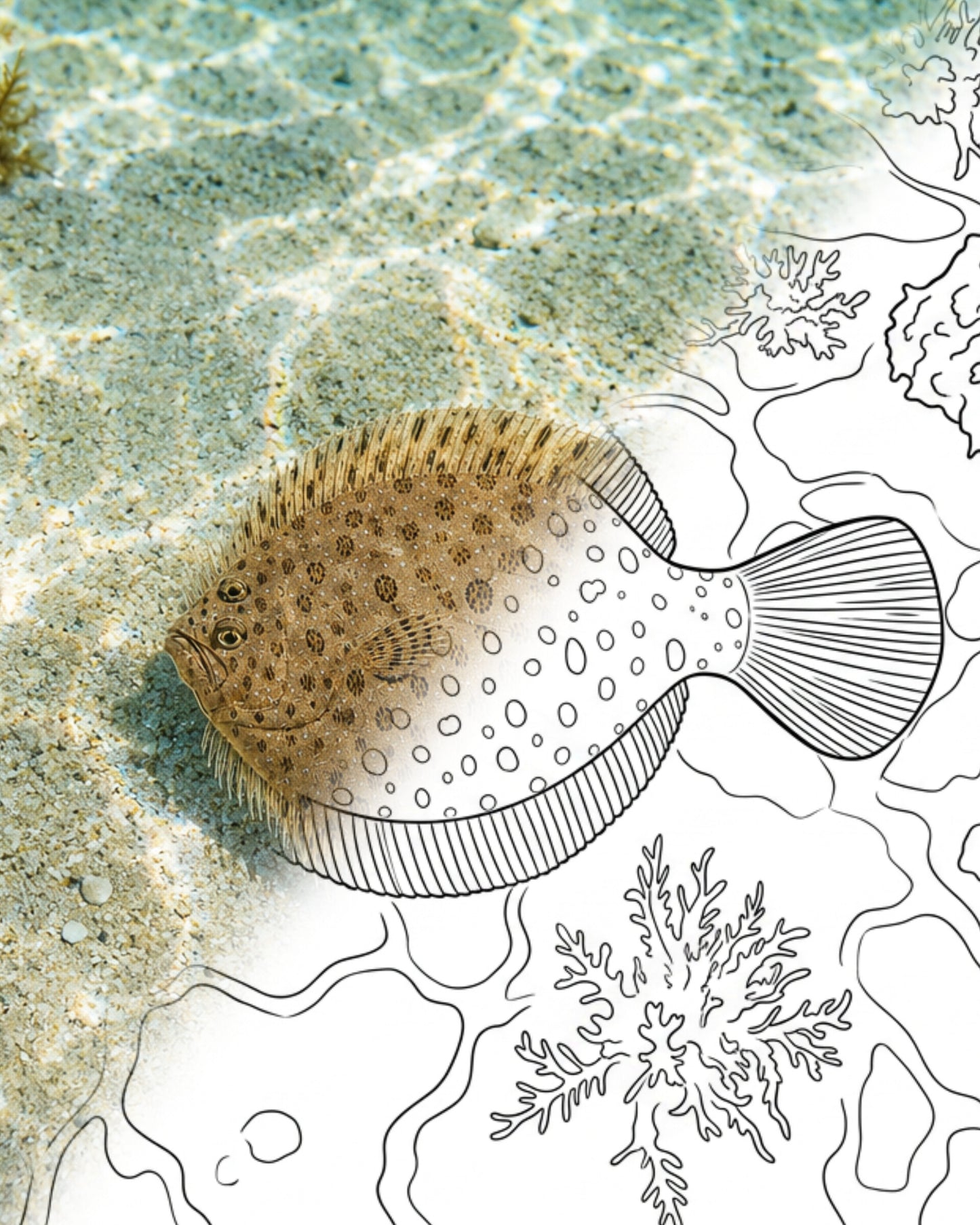
Windowpane Flounder (Scophthalmus aquosus) | Marine Explorer Coloring Kit
Windowpane Flounder (Scophthalmus aquosus) | Marine Explorer Coloring Kit
Couldn't load pickup availability
Discover one of the most unusual and beautifully adapted flatfishes of the Northwest Atlantic coastal seafloor. The Windowpane Flounder, scientifically known as Scophthalmus aquosus, is a remarkable member of the Scophthalmidae family — a thin-bodied, left-eyed flatfish specially adapted for life on sandy, silty, and shallow coastal bottom habitats.
The body of Scophthalmus aquosus is broad, flattened, and nearly circular in outline, giving it a distinctive disk-like appearance that immediately separates it from most reef and open-water fishes. Its sandy brown background coloration is covered with scattered dark spots, fine pale speckling, and irregular blotched markings that allow it to blend almost perfectly with soft-bottom environments. This camouflage is not decorative; it is a survival system. By lying close to the seafloor and matching the color and texture of sand or silt, the Windowpane Flounder becomes extremely difficult for predators and prey to detect.
Unlike vertically swimming reef fishes, this species lives with both eyes positioned on one side of the body, an adaptation that allows it to rest flat against the bottom while still watching the environment above. Its long dorsal and anal fins extend around much of the body, creating a soft continuous outline that supports slow, controlled movement across the substrate. The rounded tail, spotted fin rays, and flattened body shape make this fish an excellent subject for studying flatfish anatomy, benthic camouflage, and seafloor specialization.
The Windowpane Flounder is associated with shallow coastal waters of the Northwest Atlantic, including sandy bottoms, silty substrates, estuaries, bays, and nearshore marine environments. It is a demersal species, meaning it lives close to the bottom rather than swimming actively in open water. Its diet includes small crustaceans, small fishes, larvae, and other benthic prey, reflecting a predatory lifestyle built around patience, camouflage, and sudden short-range feeding movements.
This species is especially valuable as an educational coloring subject because it demonstrates a very different marine body plan from typical reef fishes. Learners can explore how asymmetrical eye placement, flattened body structure, spotted camouflage, and bottom-dwelling behavior work together in one highly specialized fish. Its subtle colors and complex spotted pattern also provide a strong creative challenge for marine artists and collectors who want to study realistic seafloor fish design.
The original reference appears to use the spelling Scopthalmus aquosus, while the accepted spelling is Scophthalmus aquosus. This product uses the corrected scientific spelling to preserve taxonomic accuracy while maintaining the educational connection to the original visual reference.
Developed using real marine reference observations and scientific classification standards.
Common Name: Windowpane Flounder
Scientific Name: Scophthalmus aquosus
Origin / Habitat: Northwest Atlantic. Found in shallow coastal marine and slightly brackish waters over sandy bottoms, silty substrates, estuaries, bays, and nearshore soft-bottom habitats.
[Exclusive Educational Content Included]
This educational coloring kit combines marine science with clean line art, helping learners and collectors explore the flattened body form, left-eyed flatfish anatomy, sandy spotted camouflage, soft-bottom habitat adaptation, and benthic predatory lifestyle of this Northwest Atlantic Windowpane Flounder through a creative hands-on experience.
Best for: hobbyists, educators, marine artists, flatfish learners, and reference collectors.
Note: Full biological profile data including habitat, diet, size, temperature, salinity, and aquarium-reference parameters is included in the Digital Infographic Card inside your download folder.
Formats included: High-resolution printable coloring page (A4 PDF) + Scientific Infographic Card.
Part of the growing CECOZ Marine Explorer Series — collect and build your personal marine library.