CECOZ
Blacksaddle Filefish (Paraluteres prionurus) | Marine Explorer Coloring Kit
Blacksaddle Filefish (Paraluteres prionurus) | Marine Explorer Coloring Kit
Couldn't load pickup availability
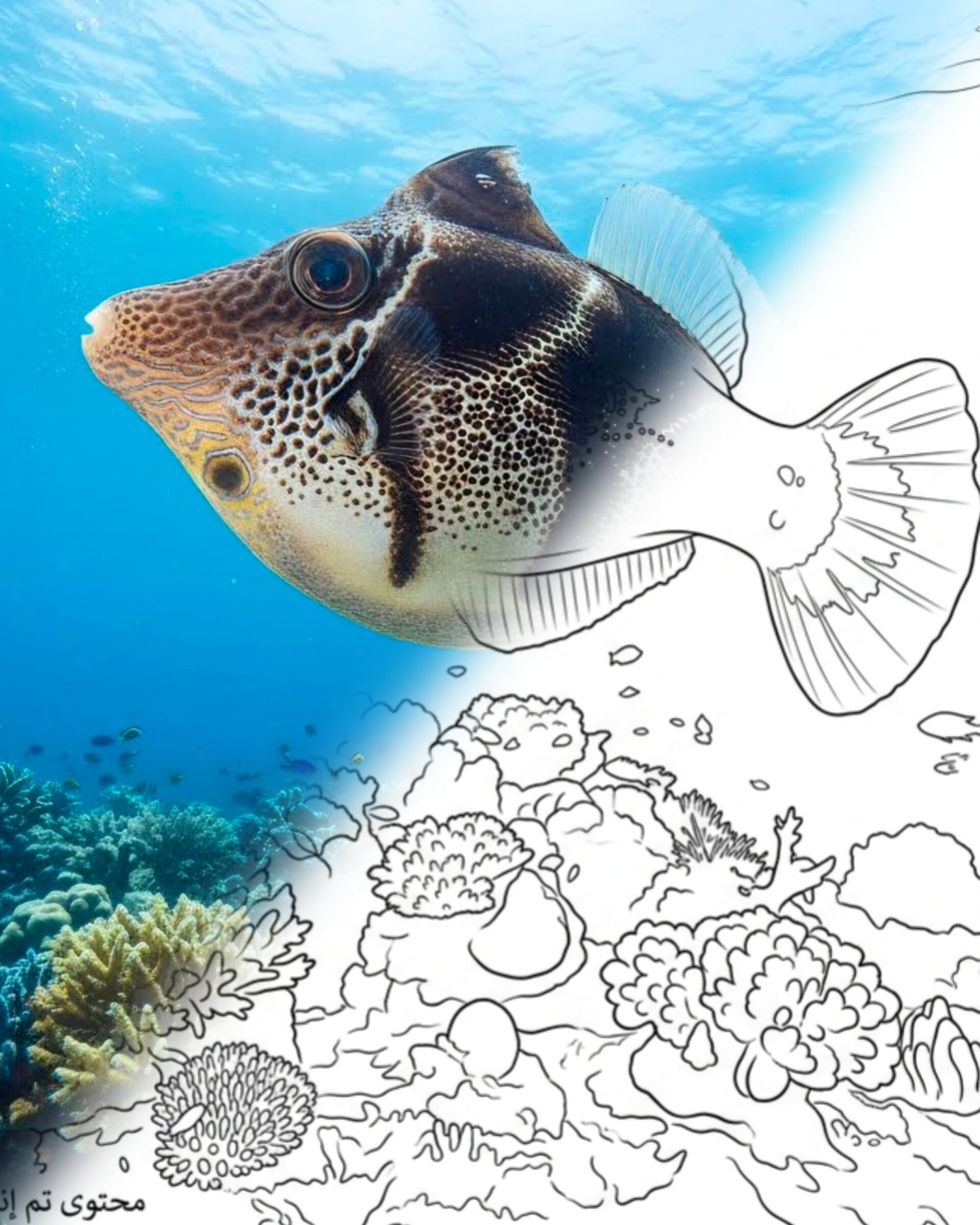
Discover one of the most fascinating mimicry specialists of the Indo-Pacific reef world. The Blacksaddle Filefish, scientifically known as Paraluteres prionurus, is a small marine filefish recognized for its bold black saddle-like body markings, yellowish tail, spotted facial pattern, and remarkable resemblance to the toxic Valentin’s Toby pufferfish. This visual resemblance is one of the most interesting survival strategies in reef fish biology.
Unlike many filefishes that rely mainly on camouflage, Paraluteres prionurus uses a more deceptive strategy: it closely mimics the appearance of Canthigaster valentini, a toxic sharpnose pufferfish avoided by many predators. This resemblance helps the harmless filefish gain protection by being mistaken for a poisonous species. In simple words, it dresses like the dangerous guy at the reef party — and honestly, that is a clever survival plan.
The species has a compressed filefish body, a small mouth, elongated dorsal and anal fin bases, a distinctive dorsal spine, dark saddle markings across the upper body, and a pale-to-yellowish tail with dark edging. These features make it visually close to the pufferfish it mimics, but careful observation reveals the filefish structure: longer fin bases, a different body profile, and the presence of the dorsal spine typical of filefishes.
In nature, the Blacksaddle Filefish is associated with clear lagoons, coral-rich reefs, seaward reef slopes, rubble areas, and shallow reef habitats. It is found across the Indo-Pacific, from East Africa across the tropical Pacific to Fiji, north to southern Japan, and south toward the southern Great Barrier Reef and New Caledonia. It is not the Red Sea representative; the Red Sea has a closely related species, Paraluteres arquat, which should not be confused with this product.
This species is usually seen in pairs, small groups, or sometimes mixed near the pufferfish it mimics. Its behavior makes it an excellent educational subject for explaining Batesian mimicry, predator avoidance, reef adaptation, and the difference between visual similarity and true taxonomic relationship. It may look like a puffer, but taxonomically it remains a filefish.
The diet of Paraluteres prionurus includes small invertebrates, algae, plant material, and prepared marine foods in aquarium-reference contexts. Its feeding ecology reflects its reef-associated lifestyle, where it forages around reef surfaces, coral structures, algae growth, and small benthic organisms.
For coloring and line-art education, this fish offers an excellent mix of bold patterning and scientific meaning. Learners can study the black saddle bands, yellow tail, spotted facial markings, streamlined body outline, fin shapes, and mimicry-based coloration. It is especially useful for students, marine biology learners, reef fish enthusiasts, and collectors interested in evolutionary strategy rather than beauty alone.
Developed using real marine reference observations and scientific classification standards.
Common Name: Blacksaddle Filefish
Scientific Name: Paraluteres prionurus
Origin / Habitat: Indo-Pacific; clear lagoons, coral reefs, seaward reef slopes, rubble areas, and shallow reef habitats from East Africa to Fiji, southern Japan, the southern Great Barrier Reef, and New Caledonia.
[Exclusive Educational Content Included]
This educational coloring kit combines marine science with detailed line art, helping learners and collectors explore mimicry, reef adaptation, filefish anatomy, saddle-like coloration, Indo-Pacific distribution, and the ecological relationship between harmless mimic species and toxic model species.
Best for: hobbyists, educators, marine artists, taxonomy learners, marine biology students, aquarium reference collectors, and fans of reef fish mimicry.
Note: Full biological profile data including habitat, diet, size, temperature, salinity, and aquarium-reference parameters is included in the Digital Infographic Card inside your download folder.
Formats included: High-resolution printable coloring page (A4 PDF) + Scientific Infographic Card.
Part of the growing CECOZ Marine Explorer Series — collect and build your personal marine library.